
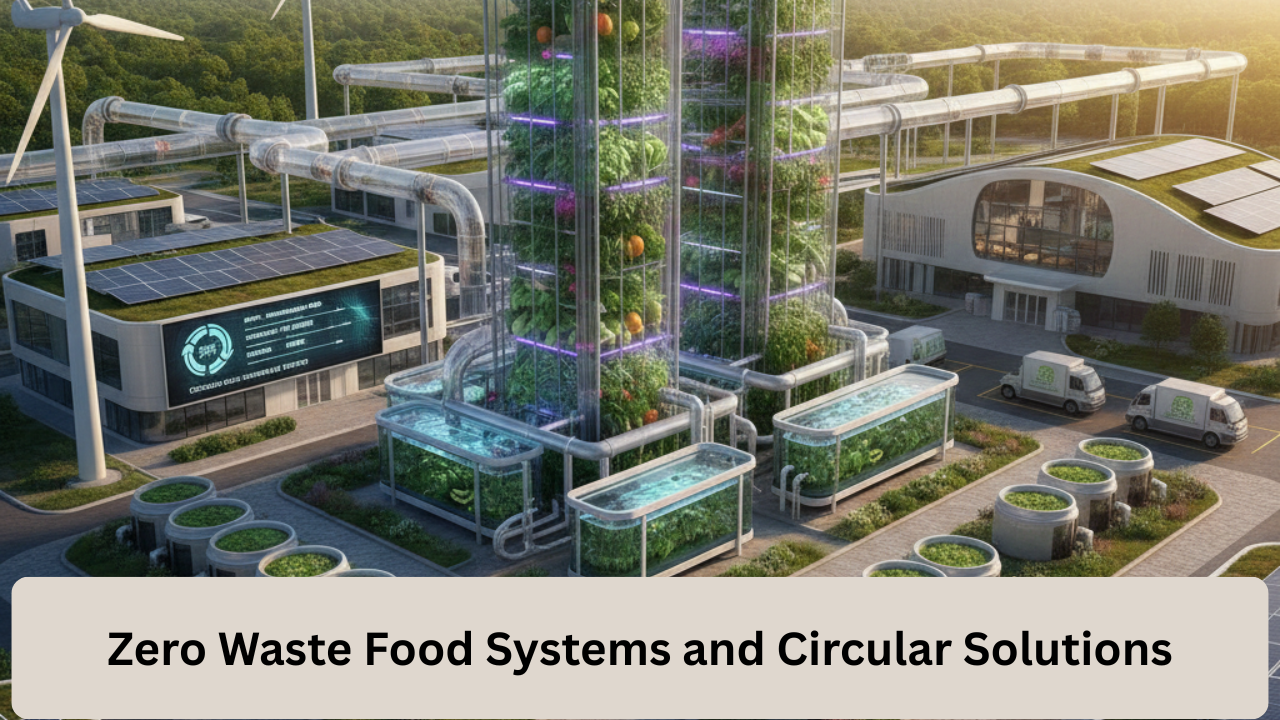
We are living in a world of weird contradictions. Now that millions of people are struggling with food insecurity the global food system a system designed to feed us all acts like an open pipe where a third of all food produced wasted. It is not a moral crisis but a design failure. As many generations, we have created a linear food system: we harvest what the land provides, prepare food and get rid of the leftovers.
Nature does not make lines however. A falling apple in a forest is not garbage, it is fertilizing the soil and insects and new plants. Our food systems need to taught this wisdom. Not only does the new paradigms of zero waste and circularity bring hope, but it also provides a useful roadmap of how we can have a food system which is sustainable, regenerative, and is an abundance to everyone in the future.
The Design error: A System Under stress.
The model of take-make-dispose that we have today is failing under its weight. Imagine a field belonging to a farmer, the harvest is just good, and in fact, is slightly deformed, but it well edible, and still not sold off due to the fact that it does not comply with the aesthetics of the supermarket. The energy, water and labor used to grow it, all gone.
This ineffectiveness is mind boggling. The Ellen MacArthur Foundation reports that a city only produces 2.8 billion tonnes of food and human waste per year, yet only less than 2% of the useful and nutritious materials are reused or recycled. The implications fling out in every direction. Food waste implies water waste, energy waste and fertilizer waste.
It is a major contributor of climate change because the organic matter that is decomposing in the landfills emits methane which is a powerful green house gas. It is not merely the waste of food that we engage in this linear model it our future that squandered, putting a heavy load on our ecosystems and leaving us due to the failure of supply chains and the lack of resources.
What a Circular Food System Would Actually Look Like?
A circular food system is not an idealistic notion, but it is a realistic redesign that will bridge the loops. It poses a very basic yet radical question: What would it mean to have no such thing as waste? Our present garbage in this system becomes a resource. It has a few fundamental principles on which it built:
Waste Prevention:
The best waste is the one that prevented. This implies farm to fork planning: farm data used to match supply and price data used to match demand and supply chains designed to have minimal loss early on.
Redistribution as a Reflex:
When there is excess edible food, the first thing to do is to divert the food to beneficiaries, and not garbage heaps. It is not charity it is common sense.
Valorization of “Waste”:
The leftovers that we cannot consume (peels, stalks, and by-products) can turned into something useful: animal feed high in nutrients, organic fertilizer, clean energy or even raw materials of another product.
Regeneration as the Objective:
The system takes an active part in improving the environment in which it relies, restoring the health of the soil, increasing biodiversity, and decreasing the dependence on artificial inputs.
Concisely, we plan waste out of existence, maintain food and nutrient as useful as long as possible and contribute to the ecology more than we consume.
The strength of a waste-less mentality.
Being zero waste does not mean being perfect; it means being more efficient and inventive. As soon as we begin perceiving food scraps not as trash but as assets, we get possibilities. As an example, a study of a comprehensive zero-waste system comprising fish farming (aquaculture) and vegetable growing (horticulture) discovered that it had the potential to increase productivity by 18 percent and reduce the operating costs by 25 percent.
Similar report brings out the role that food waste can converted into new incomes by means of microbial fermentation the so called circular bioeconomy. This transition is not only environmentally friendly but also cost-effective, to establish strength and new sources of livelihood.
A Journey through the Circular Food Chain.
Our food system needs to changed at all levels, and this will enhance a value chain.
On the Farm: Soil health and precision are the starting point of the circular journey.
Through satellite photographs and sensors on the soil, farmers will be able to add water and nutrients only where necessary, eliminating excess and overflow. Other projects such as the ZeroW project utilize technology to reduce losses before harvest and identify alternative applications of agricultural by-products.
In Processing and Manufacturing: And this where the creativity is nurtured.
The used grain of brewers, which is a by-product of beer production, can also reused to produce nutritious flour to make bread. The over-ripe or ugly fruits can be converted to tasty soups, chutneys or frozen products. This is meant to make all the by-products a potential ingredient.
Distribution and Retail:
Dynamic pricing will allow Distribution and Retail business organizations to sell items that are close to expiring, adopt ugly produce, and collaborate with food banks and applications to deliver edible leftover to individuals, not to waste.
At Home and in Restaurants: Home and in Restaurants. Reflective meal planning, learning to enjoy leftovers, and putting our food scraps into the composts are strong measures. Composting is a way of closing the circle, turning what wasted our kitchen to the rich soil which our next meal will grow.
The “End” as a New Beginning:
In this case, the real brightness is innovativeness. It has been adopted by companies such as Goterra to use black soldier fly larvae to eat organic waste that can transformed into high-protein animal feed and fertilizer and reduce emissions at landfills by up to 97 percent. To produce renewable energy, anaerobic digesters are able to extract biogas in the waste.
Conclusion
This transformation to zero waste food systems and their solutions in the form of a circle is not merely an environmental movement, but it is a paradigm shift in the way humanity produces, consumes, and values food. Waste may become an opportunity through re-conceptualizing waste as a resource and creating closed-loop systems.
In addition to reducing environmental impact and conserving natural resources, the circular models also drive innovation and generate new economic value and enhance food security among globally diverse communities. Governments, businesses, farmers, as well as consumers will have to work together to bring about this change.
The policy frameworks should also encourage resource recuperation, technology should allow smarter production and waste management and people should also develop more accountable consumption behavior. Finally, it is not only about creating a circular and zero waste food system, but regenerating ecosystems, empowering societies and providing a resilient and sustainable future to the future generations.
