
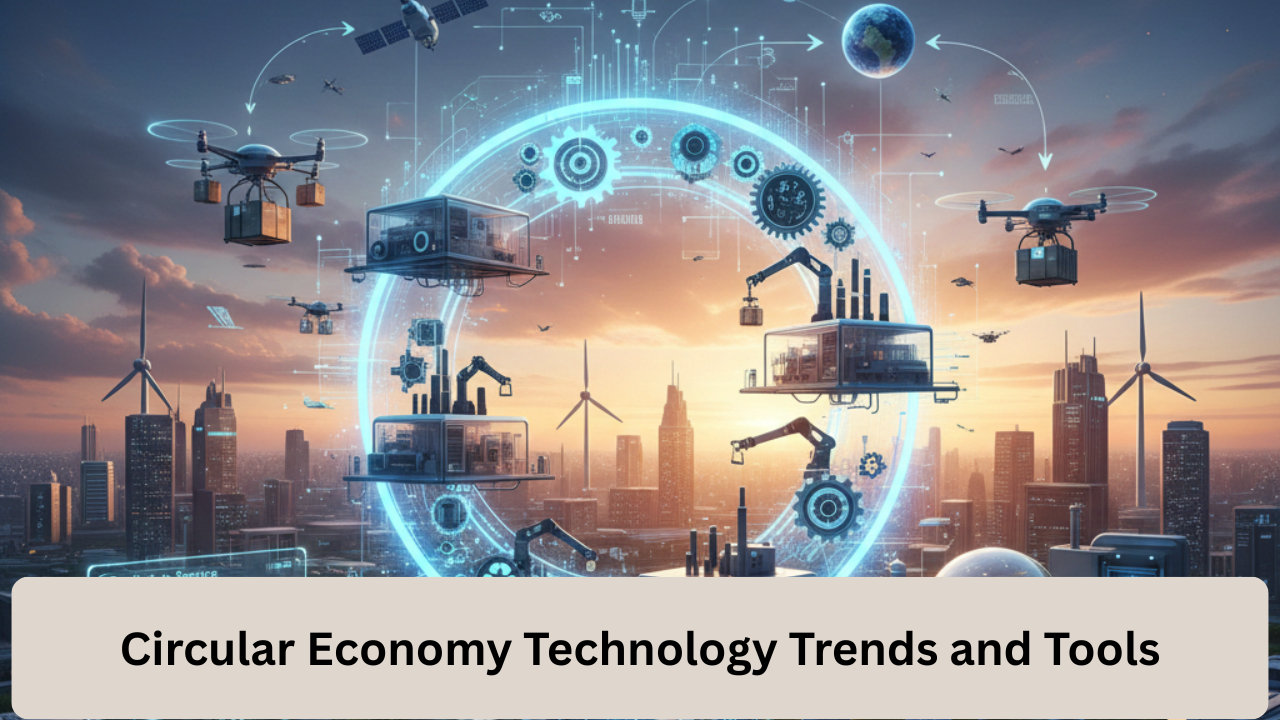
Circular Economy Technology Trends and Tools. Our economy was based on this simple but wasteful notion over hundreds of years: take a resource and transform it into a product and discard it. We excavate, we construct, and we dispose. It passes directly out of a mine or a forest to a landfill. But could we not make that so as to be a circle?
The circular economy’s simple, strong idea is to use resources as long as possible, maximize their use, and identify new ways to renew them at the end of their life. The conversion of a linear to a circular environment is not only a desirable idea but is also a strategic necessity. And the hidden weapon that enables it? Tech.
There is a powerful overlap between digital and physical technologies that is providing us with the ability to finally bridge the gap and turn waste into wealth and more efficient systems. Let us consider the important technological advances that are currently contributing to this silent revolution and how your company can be a part of it.
The five Tech Superpowers that are transforming our world.
The circular economy is not a technology but a cluster of technologies working together. These are the key personalities that are revolutionizing the game:
AI: The System’s Smart Brain
Consider a recycling facility whereby a machine can quickly locate a bit of black plastic, which has always been difficult to sort. It is now achievable through AI and machine learning. These are devices that use computer vision to identify and classify objects that a conveyor belt carries more effectively than a human being can. However, these devices do much more than just sort objects.
AI can also know a crucial piece of production equipment is prone to failure, and therefore, the repair process can be made based on this information, preventing the failure of the unit, which can extend its lifespan by a few years. The optimization of these resource flows is ensured by AI to guarantee that products have a longer lifespan and require fewer new materials. This saves the world as well as money.
Internet of Things: Things to Talk About.
What would happen should a product be able to narrate about its life? This can be so due to the Internet of Things (IoT), which comprises networks of small-sized connected sensors. Imagine a smart bin in a city that will tell you when it is full up to the brim. This allows the garbage trucks to strategize their routes, which are fuel and emission efficient.
Or consider a rented power tool with a sensor installed in it to monitor the frequency of use, the healthiness of the tool, and the state of its maintenance. This information assists the person who makes it to repair it fast and hire it out once more, which continues the process of use. IoT transforms dumb things into smart assets by providing them the real-time data that they need to operate in a circular system.
Blockchain: The Trust Chain You Can Never Break.
Where was this, and is it recycled or not? The most significant one in the circular universe is trust. Blockchain technology would monitor a product in all its forms of existence since its raw materials with an immutable digital registry. It is a big deal when it comes to the ability to trace things. Means that a company can support its claims of being environmentally friendly, preventing the occurrence of greenwashing.
It also opens the new business models. As a case in point, the blockchain is capable of a payment through the use of a smart contract that will automatically make a payment once an item that has been leased is returned so that it can be reused and remanufactured.
Innovative Materials: The Components that generate Regeneration.
It can even be the problem of the substance itself. Most of the things existing today are very difficult to recycle. Here is where the field of material science comes in. There are numerous things being developed, such as chemical recycling technologies to break down the polymers and make them into their molecular building blocks to create new, high-quality plastic, or biofabrication to grow packaging out of mushroom roots (mycelium) or algae. These materials are designed so that they can be composted or broken down safely in the first instance; hence, they may be recycled to the biological or technical cycle without polluting the environment.
Digital Platforms: A Second Chance to Last Long.
Technology is not merely about things; it is about establishing connections. The digital platforms of the marketplaces and operating systems of the circular economy are a digital platform. They operate the sharing economy of tools and equipment, simplify the sale of worn clothes and manage the complex logistics of the Product-as-a-Service (PaaS) models. You do not purchase a light bulb under a PaaS model; you purchase light.
The company is the owner of the fixture and the bulb, maintains them in an excellent condition to ensure that they operate efficiently and then gives them back to retrieve valuable materials upon expiry. These platforms alter the economic incentive of selling more items into providing better service with a longer duration of service. Tools That You Can Use Now: The Theory to Practice.
Your Circular Future Plan.
It is not about anything single, but a process towards achieving it. To get started, do this:
- Begin with a map: You can never manage anything without knowing how to measure it. Learn about your current material flows with the help of IoT sensors and data analytics. What are your biggest wastes? Which products will most probably get the second life?
- Test on a new model: Don’t attempt to boil the ocean. Start with tiny things. Is one of your goods a service you can provide? Are you able to initiate a program that will restore your most valuable core components? Learn and get things going with these pilots.
- Design Circularity Circularity: The greatest thing you can do is to design things in a different way. Think, “How do we make this easy to fix, upgrade, and someday take apart? Such planning in advance will save much time and money in the future.
- Collaborate on a massive scale: A circular economy does not occur automatically. As a way of making a circularity successful, one must get into conversations with his suppliers, consumers, and even his competitors. This partnership is held by digital platforms and shared data.
Conclusion
The shift to a circular economy is one of the major shifts in altering how societies and businesses consume their resources. The power behind circularity has been technology and the need to make it possible and scalable as global issues such as climate change, resource depletion, and accumulation of waste continue to worsen. AI, IoT, blockchain, and advanced materials are new technologies not only facilitating a smoother operation of things; they are also altering the very way we do things and how we make them.
They are the technologies that allow us to control the resources more wisely, monitor the materials in real-time, operate open supply chains, and develop new business models, where it is worth considering reuse, remanufacture, and durable goods instead of their destruction. Digital product passports, predictive analytics, and sharing platforms provide businesses with the means they require in order to be greener and create new business opportunities.
However, real circularity does not imply only the acquisition of new technologies. It requires collaborating within systems, openness of information, and a commitment to designing their products and services with their entire lifecycle considered. Businesses, governments, and people should all unite to close the loop of waste and create systems that can prosper within the boundaries of the earth. Ultimately, all possible things done because of technology but all things.
