
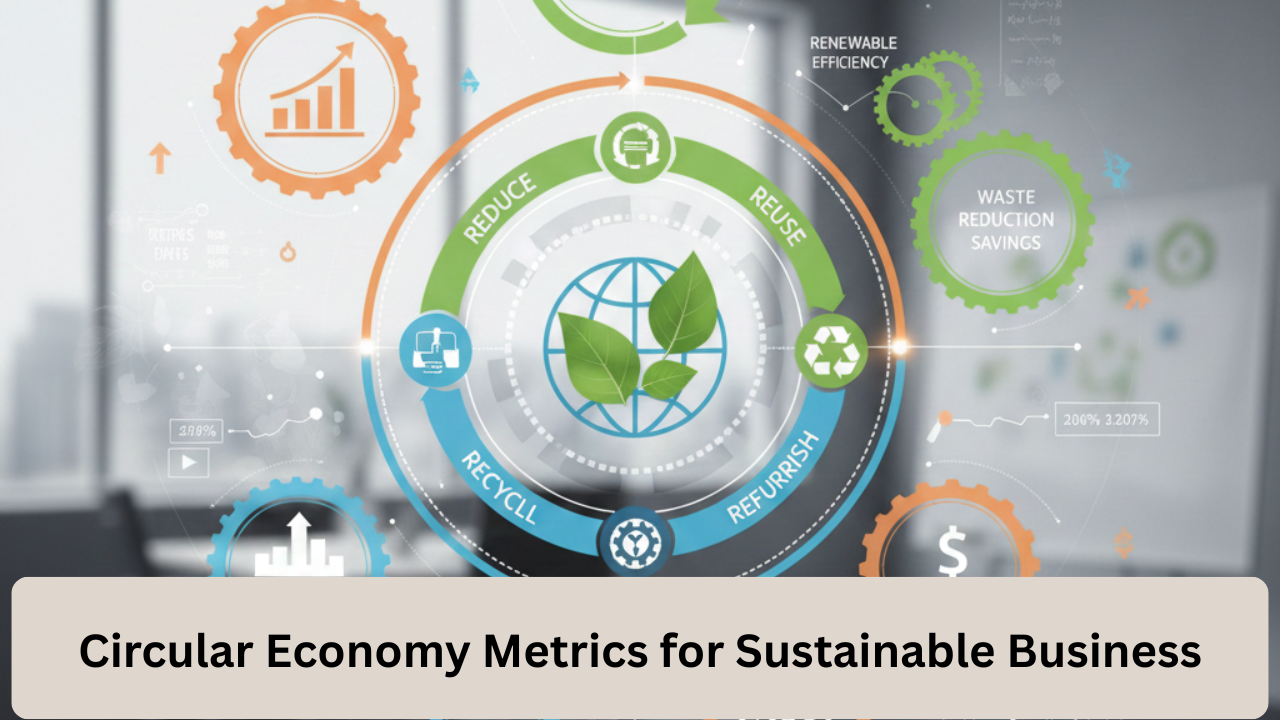
The rise of the circular economy as a business concept has been a radical solution to the challenges of business expansion in an environmentally non-destructive manner due to the increasing environmental issues and the shortage of resources. The circular model attempts to make the loop complete by utilizing materials, parts, and products as long as possible. This is opposed to the normal linear economy in which it operates as follows: take, make, dispose. This transformation is not only likely to reduce waste but also to make the economy stronger as a result of efficient resource use and creation of new ideas and growth.
However, with increasingly more businesses adopting circular approaches, one significant issue arises, namely, how circularity can be quantified. It may mean that companies may circumscribe their statements regarding sustainability as long as they lack clear and consistent metrics. Therefore, there is a need to develop and apply beneficial circular economy indicators to monitor the progress, take decisions, and demonstrate actual environmental performance.
The significance of metrics in the circular economy.
In cases when the circular change occurs, the process guided by metrics. They can help businesses gauge their resource utilization efficiency and locate where waste has become an issue and can also monitor the effectiveness of such circular strategies as product reuse, remanufacturing, or recycling.
Strong measures also taken when looking at things in a strategic way.
Assist individuals to draft the goals and monitor their achievement, in order that companies can establish actual goals that are congruous with their sustainability objectives.
- Ensure that things are more transparent and responsible by providing credible information to the investors, regulators, and customers.
- Encourage new ideas and competition, because measuring things often shows places where things aren’t working well and ways to make them better.
- Make it easier to follow new rules, like the EU’s Circular Economy Action Plan or extended producer responsibility (EPR) programs.
The problem, though, is that circularity is hard to understand. It includes supply lines, product life cycles, and many environmental aspects, such as biodiversity, energy use, materials, and emissions. So, coming up with complete and useful metrics needs a mix between being scientifically sound and being useful for business.
Various Metrics of a Circular Economy.
Circular economy metrics divided into three primary categories, namely, those that resource centric, the ones that product centric, and the ones that system centric. They both provide a new perspective on outcomes.
- Metrics Based on Material
Such measurements demonstrate the efficiency of a business in its management of actual resources in the production and utilization. They encompass such aspects as the consumption of resources, generation of waste, and recyclability of materials. MCI is abbreviation used to denote Material Circularity Indicator.
The MCI, created by the Ellen MacArthur Foundation and Granta Design, is a measuring instrument that determines the restorative nature of the material flows of a product. It provides a scale of 0 (linear) up to 1 (fully circular) on the ratio of new materials to added materials over the recycled or reused materials.
- Recycling rate (RR) explains what percentage of materials that were utilized reintroduced at the end of their useful life.
- Virgin Material Consumption (VMC) a measure of consumption of new raw material and it indicates when recycled materials or green materials can used instead of new ones.
- Waste-to-Resource Ratio (WRR): This metric shows the quantity of waste that converted into the new resources and it shows how much the economy improved.
- Material-based measures come in especially handy in resource heavy industries like consumer goods, building and manufacturing.
Product-Based Metrics
They product- oriented business plans. The factors that counted when deciding the level of circle of something include design, durability, maintenance, and end-of-life recovery.
- Product Longevity Index (PLI) is a measure of the duration of usefulness of a product and its still demanded after it has to disposed of.
- Reusability and Repairability Scoring: The French Repairability Index and other tools provide the score on products according to how easy they are to disassemble, the existence of replacement parts and how they documented terms of repair.
- The Recycling Potential Index (RPI) determines how fast and successful the recovery of components of a product can achieved without damaging the quality.
- The Circular Design Score (CDS) intended to be updated and verifies that a product was manufactured using flexible and renewable materials.
It is these measurements of the performance of each product that aid eco-design that makes goods last longer as well as possess less impact on the environment from the time they manufactured up to the time they discarded.
Measures help you to plan the way you will run your business.
To utilize the measures of a circular economy well, it is best that you not only gather the data but also apply them to make good decisions. It can usefully done the way illustrated the steps below:
- Flow Mapping Material: It is necessary to do this by first listing all the resources that enter and leave and the garbage it creates.
- Indicator Choice: Select measures that are suitable to the size and nature of the business with long-term sustainable objectives of the company.
- Acquiring and Interpreting Data: Track the data about materials and products in real-time using such digital tools as life-cycle assessment (LCA) software, IoT devices, and blockchain.
- During benchmarking, comparisons between your work and the best practices, business standards, or government standards made.
- Communication and Reporting: To make it even more convenient, circular measures are to incorporated the sustainability reports and company ESG statements.
- Always Getting Better: Plan the goods and supply lines and apply what you have learned to improve them.
In their daily operation, businesses can transform them into tools used to achieve compliance and into the providers of new ideas and competitive advantage by means of measures.
Conclusion
The shift toward a circular economy is not only an environmental requirement but also a business prospect to achieve success within the boundaries of the planet. But, unless these happen to measured effectively and continuously, then circular initiatives may be more of a symbolic change than a change of direction. Measures of a circular economy offer the necessary framework through which to measure the improvements, detect areas of inefficiency, and prove the actual value through sustainable production.
The combination of measures like material circularity, product lifespan, and indicators at the system level can help businesses to close the gap between data and actionable ideas, which can used to drive design innovation, resource optimization, and responsible growth. Not only do these measurements improve transparency and accountability, but they also increase competitiveness in a world that is increasingly becoming sustainability performance-oriented.
Finally, circular economy indicators will enable organizations to shift toward action. They help businesses keep a record of their progress—and how much more they can achieve—in developing regenerative business models that uncouple growth and resource consumption. By so doing, they will provide a stronger, fairer, and more sustainable world economy.
